Hello Guest User,

Please feel free to have a look around the forum but be aware that as an unregistered guest you can't see all of it and you can't post.

To access these 'Registered Users Only' areas simply register and login.

A Four Cylinder W1400? …A Midlife Update of my retro styled Z

Work in Progress

Moderators: chrisu, paul doran, Taffus, KeithZ1R

Message
Author
User avatar
j.wilson
100Club
100Club
Posts: 222
Joined: 23rd Jul 2011
Location: wimborne

A Four Cylinder W1400? …A Midlife Update of my retro styled Z

#1 PostAuthor: j.wilson » Mon Jan 26, 2026 3:38 pm

My “W1400” has been a faithful companion to me for over 15 years now; finished in September 2010 and ridden hard ever since.
Some of you will remember the original build project that was lost to the ether; the Z650/1100 Bonneville hybrid.

007 opening pic.jpg

She's carried me the length and breadth of England and Wales, crossed to Western Ireland on multiple occasions (those Atlantic winds and twisty coastal roads are unforgettable), and even made a spring break down to Spain for a particularly memorable adventure last year.

009 Travels on the open road.jpg

The bike has proven itself time and again: characterful and always puts a smile on my face with that deep four-cylinder shove and light-footed handling.

But as the years stack up, the reality of parts availability starts to creep in. Some of the refurbishment items I relied on back then, the 82mm pistons and cylinder block for example, have become obsolete.
Rather than wait for something critical to fail on a remote B-road in Wales, I decided it was time for a Midlife Update.

The goal isn't a full redesign; it's preservation with sensible upgrades, replacing wear items, addressing any age-related fatigue, improving details that have revealed themselves over thousands of miles, and ensuring the bike stays enjoyable and dependable for another decade or more.

Right now, she's in bits on the bench, engine out, frame stripped, tank off, wiring loom laid out, giving me the perfect opportunity to document the assembly process step by step, and reflect on the original concept that drove the whole project back in 2009–2010.

008 coming apart.jpg

The Midlife Update: What's Happening Now

The philosophy remains unchanged: keep the soul of the original W1400 …classic style, effortless torque, light-footed handling, real-road usability, but refresh it thoughtfully so parts scarcity doesn't become a barrier. No radical changes; just careful maintenance and subtle improvements where time and miles have shown the way.

I'll document the rebuild here as it progresses with photos of the specific parts replaced or upgraded, any surprises and lessons learned, and reflections on what has stood the test of time. I hope you find it interesting and if anyone remembers the original build posts or has followed along over the years, I'd love to hear your thoughts or questions as we go.

She's coming back together stronger and ready for the next chapter; more miles, more adventures, and hopefully fewer worries about obsolete bits.

The W1400 was always meant to be ridden, not preserved in a garage, and this midlife update will keep her on the road where she belongs.
z650/1400 bonneville hybrid.

r3sc
Custard Cream
Custard Cream
Posts: 758
Joined: 24th Nov 2019
Location: Sheffield

Re: A Four Cylinder W1400? …A Midlife Update of my retro styled Z

#2 PostAuthor: r3sc » Tue Jan 27, 2026 8:54 am

Looking forward to this update!

User avatar
j.wilson
100Club
100Club
Posts: 222
Joined: 23rd Jul 2011
Location: wimborne

Re: A Four Cylinder W1400? …A Midlife Update of my retro styled Z

#3 PostAuthor: j.wilson » Tue Jan 27, 2026 3:25 pm

.
The W650

001 W800 timeline.jpg

The Kawasaki W650 (1999–2007) stands as a beautifully timeless naked motorcycle, masterfully blending the classic British style of the 1960s Triumph Bonneville with the
renowned reliability of Japanese engineering. Its very name pays homage to Kawasaki's own W-series twins from the 1960s and 1970s (W1, W2, and W3), while the bike
itself captured the spirit of retro charm without sacrificing modern usability.
What truly distinguishes the W650 is its on-road demeanor. Despite a solid kerb weight around 216kgs, the bike's geometry …..27° rake, 108 mm trail, and a 1,465 mm wheelbase,
delivers surprising lightness and sure-footedness. It inspires genuine confidence, whether carving twisty backroads, navigating town traffic, or savoring a leisurely Sunday ride.

The upright riding position is a masterclass in comfort: high, wide handlebars keep wrists relaxed, the generous, well-padded seat supports the rider's back hour after
hour, and the footpegs are positioned just right for natural posture. Miles melt away with minimal fatigue, making it an easy, engaging, and deeply relatable machine,
ideal for everyday use yet brimming with character that elevates every journey.
In essence, the W650 is a motorcycle that consistently puts a smile on your face the moment you swing a leg over it.

What's not to love?

For the more enthusiastic rider, the primary drawback has always been its modest power output.

The parallel-twin engine delivers a gentle, "put-put" character rather than outright thrust with just 48hp. This becomes especially noticeable with a pillion on board or
when attempting brisk overtakes. The successor W800 (introduced in 2011 with EFI and a larger 773 cc displacement) offered slightly more low-end torque but didn't
dramatically transform the performance equation.

The Pursuit of More Power: Engine Swap Exploration
Tuning the original engine or sourcing significant aftermarket performance parts proved challenging. The W650/W800 never achieved the massive sales volumes of rivals
like the Triumph Bonneville, so a dedicated high-performance parts ecosystem never fully materialized. The options for meaningful gains were limited.
Swapping in an entirely different engine presented its own hurdles. The real difficulty lay not in sourcing a more potent motor, but in mating it cleanly to the frame.
After evaluating options, my focus shifted to a 1970s-era frame paired with an 1980s air-cooled four-cylinder engine.

The winner: the tight, compact frame from the early Kz650 B1 (1976–1977 models), combined with the Gpz1100 A3 two-valve engine (1,089 cc, delivering around 100 plus
horsepower in period form). The ultimate incarnation of Kawasaki’s air cooled four.

This pairing promised the best of both worlds; the compact, agile and sure-footed geometry of the Kz650 frame with the muscular punch of the larger 1100 motor.

003 Kz650 and Zx1100A3.jpg

The Kz650 frame's steering geometry (27° rake, 106mm trail, 1,437mm wheelbase) aligned closely enough with the W650/W800's setup to offer comfort, practicality,
maintain the retro look, familiar handling traits, while offering a proven foundation for the engine swap. Fitment was feasible, allowing the project to prioritize styling
refinements over major chassis re-engineering.

004 Rake and Trail table.jpg
004 Rake and Trail table.jpg (84.45 KiB) Viewed 257 times

Compare the stock W800's geometry to the Kz650's and that of the ZX1100 in the table above. Culminating in my custom hybrid (W1400): tighter proportions for quicker
steering response than the big, heavy and long ZX1100, but paired with the added grunt that transforms this hybrid into a spirited, grin-inducing retro bruiser.
This custom build preserves the soul of the W-series while addressing its key limitation;
delivering classic looks with genuine muscle.

012 Bike Drawing.jpg

The project got serious once I started spending money and purchased the donor parts: a classic Kz650 frame from 1978, paired with a late-model Gpz1100 air-cooled
inline-four engine (the big, torquey flagship motor from Kawasaki's early-1980s era).
Rather than chase the Gpz1100's original top-end-biased character, designed for blistering straight-line speed, I prioritized the lazy, arm-stretching midrange torque
that defines a true muscle bike.

The solution?
A substantial upgrade via a 1394cc big-bore kit.

This capacity jump (from the stock 1,089 cc) transforms the engine's power delivery: deeper low-to-mid rpm grunt for effortless roll-on acceleration, open road overtakes
without drama, and that satisfying shove in the seat that the original W650/W800 always lacked. Why settle for subtle when you can have character?

With the engine destined for serious reconditioning, I entrusted the work to Ray and Steve at Debben Performance in Ringwood, ….the Hampshire specialist in classic
Japanese performance rebuilds, restorations, and modifications. Known for their expertise with Kawasaki's older fours (including crank work, head flowing, and big-bore setups),
they handled the meticulous prep to ensure reliability under the increased displacement and stress.

Thus, the W1400 was born: a conceptual name that fuses the W-series' timeless retro silhouette with the muscular heart of a bored-out Gpz1100, all wrapped in the agile,
compact and surefooted Kz650 chassis.

The build philosophy stayed true; keep the light, agile feel of the original W while banishing the "put-put" character. With the frame's compact geometry providing the
foundation, engine fitment became the critical path -requiring the removal of the old engine mounts and precise alignment of new custom mounts, so that the engine
fits snugly between the lower frame tubes.
From there, the focus could shift to the real magic: a sympathetic re-style that honors the W650's classic lines while subtly nodding to its newfound muscle.

Once the ginder came out, there was no turning back. I had to be sure this was the right thing to do.

The goal promised to be far more than a parts-bin special. I wanted a refined retro bruiser; with comfortable upright ergonomics for all-day rides, predictable handling
on twisty lanes, and a genuine shove that makes every throttle twist rewarding.

Once complete, the W1400 would deliver grins in spades: classic style, modern usability, and torque that finally matches the bike's soul.

Let’s get butchering!
z650/1400 bonneville hybrid.

User avatar
chrisNI
Site Admin
Posts: 3841
Joined: 22nd Dec 2001
Location: NI

Re: A Four Cylinder W1400? …A Midlife Update of my retro styled Z

#4 PostAuthor: chrisNI » Wed Jan 28, 2026 9:10 pm

Good stuff! :D :D

User avatar
j.wilson
100Club
100Club
Posts: 222
Joined: 23rd Jul 2011
Location: wimborne

Re: A Four Cylinder W1400? …A Midlife Update of my retro styled Z

#5 PostAuthor: j.wilson » Sat Jan 31, 2026 11:15 pm

W1400 or bust.

With the W1400's overall vision firmly in mind, I made a conscious decision right from the start to resist the temptation of loading the bike up with every shiny, aftermarket trick part I could find. I'd been down that road before, building motorcycles that looked spectacular on show stands but ended up as frustrating and impractical because nothing quite fitted together stylistically or worked in harmony on the road. This time had to be different.

I set myself a clear goal: a refined, rideable retro muscle bike that kept the timeless W-series soul, added the midrange torque I'd always craved, fitted me pefectly and stayed practical on real roads rather than just posing.
I also wanted an understated bike that looked like it came from a factory. Every part I bought, no matter how modest or “cheap and cheerful,” had to look like it was meant to be there.

By far the biggest challenge turned out to be the fuel tank.
Virtually every tank designed for traditional twin-cylinder retro bikes was far too narrow to compliment the wide inline-four engine and held too little fuel for anything approaching a decent riding range, especially one with a 1394cc motor that was never going to sip petrol.

My initial thought was to take an original tank and have it heavily modified to fit, but after a long conversation with Simon Parker at Parker Fabrications in Bournemouth, he convinced me there was a much better way. Instead of butchering something old, we would create a brand-new aluminium replica of a Triumph Thunderbird tank.
The Thunderbird shape already echoes the W800's classic lines but sits noticeably larger and wider, perfect for what I needed.

061 Parker Fab.jpg

Simon took the donor Thunderbird tank I picked up for just £13 on eBay and used it as a male mold. He then shaped and welded aluminium sheet sections around it to form a completely custom tank. The result is lighter than steel, completely rust-proof, fully compatible with modern ethanol-blended fuels, and crucially, shaped underneath to sit cleanly on the Kz650 frame rails and mounts. If it ever gets dented in the future, repairs will also be straightforward.
It was exactly the elegant, future-proof solution I was looking for; although is was also the single most expensive part of the build.
z650/1400 bonneville hybrid.

User avatar
j.wilson
100Club
100Club
Posts: 222
Joined: 23rd Jul 2011
Location: wimborne

Re: A Four Cylinder W1400? …A Midlife Update of my retro styled Z

#6 PostAuthor: j.wilson » Sat Jan 31, 2026 11:32 pm

.
Have you got an Ethanol problem?

Why is the inside of your fuel tank suddenly getting rusty?
Could it be global warming?

Rust
It is common for water to be introduced during refueling, e.g., from a contaminated station pump or underground tank.
This problem is becoming more common.
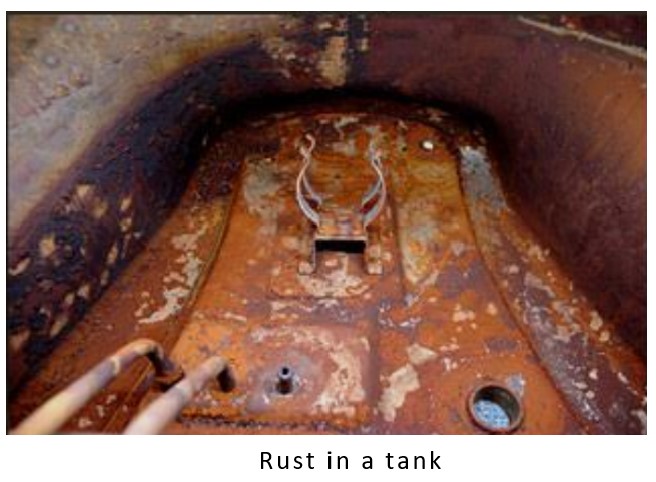
062 Rust in a tank.jpg
062 Rust in a tank.jpg (65.7 KiB) Viewed 84 times

The bare steel inside of an older motorcycle fuel tank will rust when this water lies at the bottom. But contaminated fuel is not our only source of concern. Water contamination also comes from a combination of condensation from temperature fluctuations and the hygroscopic (water-attracting) nature of modern petrol blended with ethanol (typically E5 or E10 in the UK, containing up to 10% ethanol).

Condensation
The empty space (headspace) above the fuel level in the tank is filled with air, which always contains some dissolved moisture (humidity). As temperatures drop overnight or during storage, the air cools and its relative humidity rises. When the temperature differential between the air and metal reaches a certain level, condensation forms on the cooler metal surfaces inside the tank, much like condensation on a cold window.
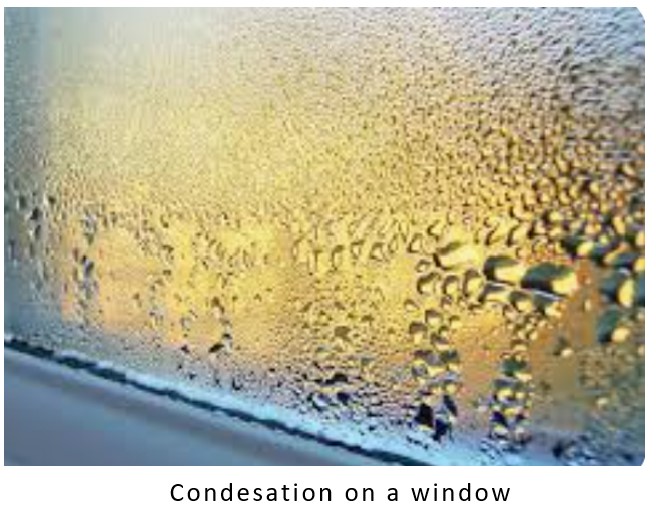
063 Condensation on a window.jpg
063 Condensation on a window.jpg (85.23 KiB) Viewed 84 times

This condensation runs down and mixes with the fuel or passes through it, eventually settling at the bottom as a layer of water.

Water alone can cause rust on the bare steel inside the tank base over time:

Simple oxidation: iron + water + oxygen → rust.

We have always lived with this problem, but the addition of ethanol in E5 & E10 petrol has changed things.

Water absorption
Ethanol is hygroscopic (it attracts and absorbs water from the air) and acts as a solvent that helps blend a certain amount of water into the petrol making it slightly cloudy.
Under normal conditions, E10 can hold about 0.5% water by volume in solution at around 15–21°C roughly 4 teaspoons per gallon.

However, its water holding capacity decreases as temperature drops: at lower winter temperatures you might be pumping fuel from a relativley warm underground tank in the forecourt and putting into your cold fuel tank (or a tank that will become very cold overnight). At lower temperatures, the fuel can reach water saturation point.

When the fuel exceeds this saturation point the excess water can no longer stay dissolved (in the way that fog forms in damp cold air). At this threshold, the ethanol preferentially bonds with the water molecules, pulling it out of solution.

Phase separation
This creates two (or sometimes three) distinct layers in the tank:
A top layer of mostly petrol, a heavier bottom layer of ethanol + water (a milky, vinegar-like mixture, sometimes called the "ethanol/water cocktail") and possibly a small acidic water layer at the very bottom as separation progresses.
This process is called phase separation because the fuel "phases" (separates) into immiscible layers.
It is temperature-dependent: colder conditions accelerate it by reducing water solubility, and warmer temperatures can delay it, but also allows more total water uptake making the fuel more sensitive to the problem.
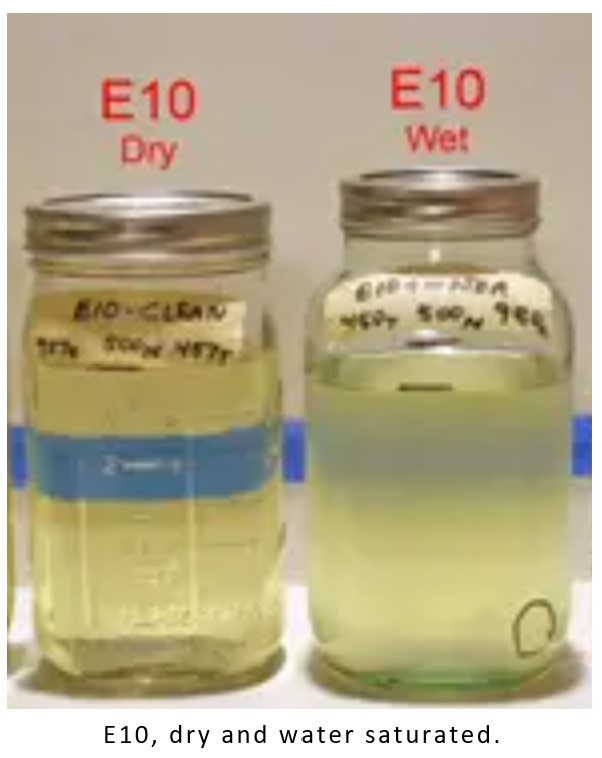
064 E10 Dry and saturated with water.jpg
064 E10 Dry and saturated with water.jpg (50.62 KiB) Viewed 84 times

This is a new problem we are facing because of ethanol, but its not the only one.

Oxidisation
When ethanol is exposed to oxygen in the headspace air (especially during storage or when the fuel tank isn't kept brimmed), it undergoes oxidation. This process forms acetic acid (ethanoic acid, CH₃COOH, the same acid in vinegar) and water.

The reaction is: Ethanol (C₂H₅OH) + oxygen → acetic acid + water

The acetic acid dissolves in the condensed/phase separated/oxidized water, creating a dilute acidic solution (vinegar-like) that's heavier than petrol and sinks to the tank bottom.

It is this acidic nature that poses the greatest corrosion problem.
This vinegar like liquid sits against the bare metal at the bottom of the tank, accelerating corrosion significantly more than plain water ever would. Acetic acid is particularly aggressive on mild steel (especially on welds), leading to pitting, rust flakes, and eventual tank perforation if left unchecked.

This isn't just theoretical, studies and real-world reports confirm that ethanol blends promote corrosion in steel tanks and fuel systems, predominantly via acetic acid formation.
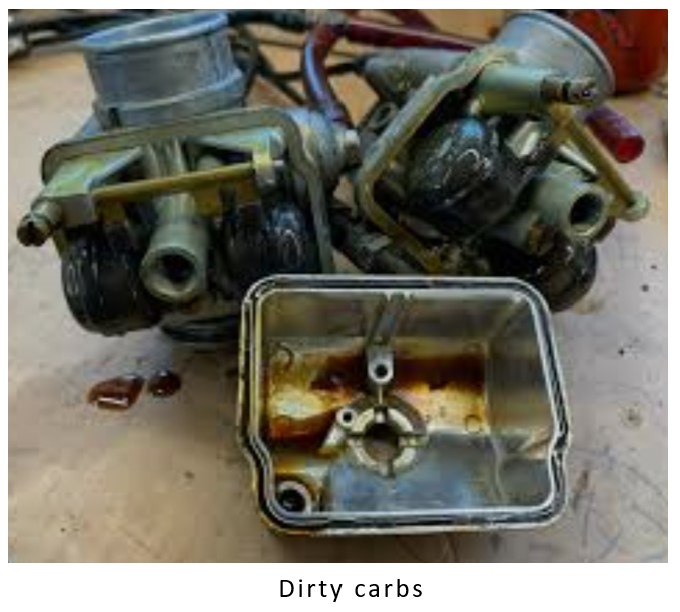
065 Gummy Carbs.jpg
065 Gummy Carbs.jpg (74.23 KiB) Viewed 84 times


Bugs too
Microbial involvement can worsen the problem: certain bacteria (like Acetobacter) thrive at the water-ethanol interface, they live in the water at the bottom of the tank whilst feeding on ethanol and they excrete more acetic acid (creating a process called microbiologically influenced corrosion or MIC). This is more common in long-stored fuel or underground station tanks but can occur in vehicle tanks too if conditions are right. This is a familiar problem for diesel, but the bugs thrive on ethanol too.
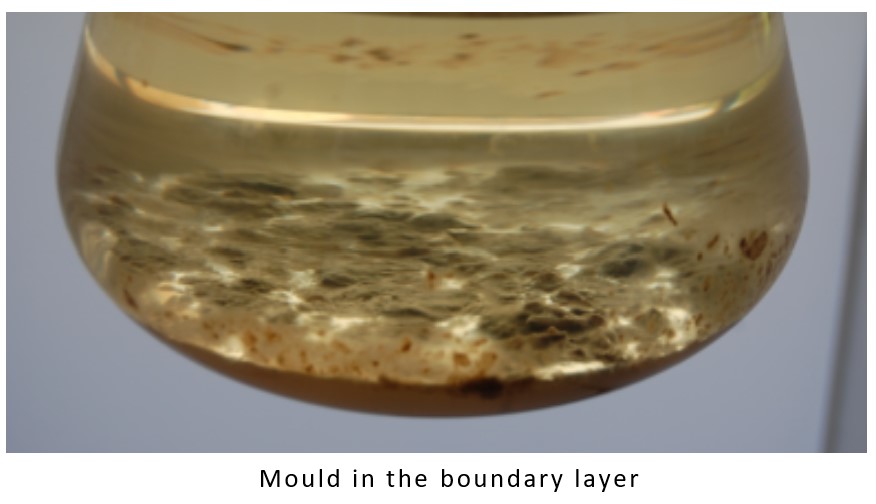
066 Mould.jpg
066 Mould.jpg (53.2 KiB) Viewed 84 times


These issue extends beyond your tank:
At petrol stations: Ethanol in underground tanks can oxidise similarly, and you might pump in already-contaminated fuel with water and acid traces. With phase transition, the water is dissolved in the fuel rather than being a contaminant (which should be removed by the separators in the petrol pump).

In carburetors: During storage, fuel evaporates slowly in the float bowls, leaving behind a concentrated fuel residue of additives, ethanol, water, and oxidation by-products. The ethanol oxidises further, forming acetic acid and gummy varnish (sticky residue from degraded petrol components). This goo clogs jets, sticks floats, and corrodes brass fittings (ethanol/acetic acid attacks brass/zinc alloys over time).

In extreme cases, a small volume of fuel (e.g., 20 ml in a float bowl) can concentrate into a thick, acidic sludge after months of sitting.

067 Ethanol Damage.jpg


Practical Prevention Tips
How do we know this is a real problem? Because manufacturers of modern bikes have gone to the expense of redesigning their products: they use plastic fuel tanks, EFI and fuel systems that are tolerant to ethanol, water and acid.
New bike suffer less.

For those with classic bikes it seems we have entered a new age where we now have a problem forced upon us. We have to do something for bikes that are only used occasionally (especially in winter).

• If you use your bike only occasionally, use alkylate fuels like Aspen or CFS Storage Plus. These fuels are ethanol-free, clean-burning, do not degrade for up to 5 years, and prevent carburetor damage, ensuring easy starting after storage. Our problems with shared by garden machinery so these fuel are often available from you Garden Equipment center.

• Use a quality ethanol-compatible fuel stabiliser (e.g., ones with corrosion inhibitors and biocides) every time you fill up, especially if the bike might sit for weeks/months. Fuel additives can provide ethanol-specific protectors and help bind water, prevent oxidation, and kill microbes.

• Consider prioritising ethanol-free petrol where available (Tesco Momentum is E5 but tests show it often has little ethanol).
Youtube: Testing The Octane And Ethanol Content Of Tesco Momentum 99 Super Unleaded Petrol 2025 Update E5 https://youtu.be/cdHZsgiuXVQ

• Keep your tank as full as possible during storage to minimise headspace and condensation.

• Drain the fuel system (not the tank) or run it dry.

• Regularly inspect the tank interior—I picked up a cheap Chinese borescope that plugs into my phone. It lets me look inside the tank (and cylinders) whenever I want, spotting water, rust, varnish, or sludge early without disassembly.

Garden power tools (chainsaws, strimmers, mowers) have faced exactly the same issue, and the response has been practical: people have adopted ethanol-free fuels where available, used dedicated stabilisers and biocides, and integrated fuel treatment into seasonal routines. Garden machinery dealers stock the right additives and alternative fuels without fuss.

In the motorcycle community—especially among owners of classics, customs, and injected retro bikes—there’s sometimes more resistance to these extra habits, as if ethanol problems won’t affect us. Yet the chemistry doesn’t care about nostalgia or build quality. Ignoring it just leads to bigger jobs and extra costs later.

The alternative? Fit a fuel filter and hope it catches the rust flakes. Put a drip tray under the bike and wait for the tank to rust through. Sniff the garage air and pray you never smell that tell-tale petrol odour indicating a leak. And if that day comes—don’t flick a light switch or create a stray spark in a vapour-filled shed. Enough fuel vapour in the air can lead to a very rapid, unplanned disassembly of your workspace.

It’s not the end of the world—getting on top of this issue is just a simple new habit. Treat the fuel properly, check your tank occasionally with the borescope, and your bike should stay trouble-free for decades more; a bit of preventive care is a small price to keep those adventures coming.
z650/1400 bonneville hybrid.

moizeau
Custard Cream
Custard Cream
Posts: 765
Joined: 3rd May 2019
Location: France

Re: A Four Cylinder W1400? …A Midlife Update of my retro styled Z

#7 PostAuthor: moizeau » Sun Feb 01, 2026 7:45 am

Nice build and a very informative piece on ethanol.
I have 5 mowers plus chainsaw, hedgecutter, 2 strimmers, 2 bikes on the road and a genny. Taking a carb off a mower takes 15 mins, diaphagm carbs are more complicated with the membranes and microscopic orifices. Bike carbs, as we all know are a pain, especially if you have the original airbox. That's why I've been using Bardahl Stabiliser for years. Touch wood, no problems. I gave the genny a service a while back, it sits with whatever fuel is left in it for upto a year. The carb was clean.
Pete

DeadZedDave
100Club
100Club
Posts: 264
Joined: 1st Nov 2021
Location: Newcastle

Re: A Four Cylinder W1400? …A Midlife Update of my retro styled Z

#8 PostAuthor: DeadZedDave » Sun Feb 01, 2026 9:11 am

Good informative write up regarding Ethanol fuel problems. It would be good to put this piece in Bike Help and pin it to the top of the list ? Ethanol petrol is not going away and will continue to be a problem for the uninformed classic owner !
Nice Zed too by the way ! I missed it first time around but will read with interest any updates. A lot of owners are going for / only interested in creating / recreating rivet counter style original spec bikes these days and its good to see a modified Zed here.
As for any questions; what camshafts do you run and what C.R. ? Also, that looks like an early type /pre 1980 cylinder block ??
I'll watch out for updates !

User avatar
j.wilson
100Club
100Club
Posts: 222
Joined: 23rd Jul 2011
Location: wimborne

Re: A Four Cylinder W1400? …A Midlife Update of my retro styled Z

#9 PostAuthor: j.wilson » Sun Feb 01, 2026 10:56 am

Thanks guys for your replies, I will keep them coming.
Engine mods soon enough.

Next I will explore the frame mods I had to make.

Roll on the sunshine
z650/1400 bonneville hybrid.


Return to “Projects”

Who is online

Users browsing this forum: No registered users and 85 guests